
Sudoku Printable
Print fresh sudoku puzzles whenever you like. Choose the difficulty and how many puzzles per page, and the generator builds new 9 × 9 puzzles that each have exactly one solution, with answer keys on a separate page. You can also solve a puzzle on screen, check your entries and ask for a hint.
- Free to use
- No sign-up
- Runs in your browser
Sudoku generator
Sudoku Puzzle Book
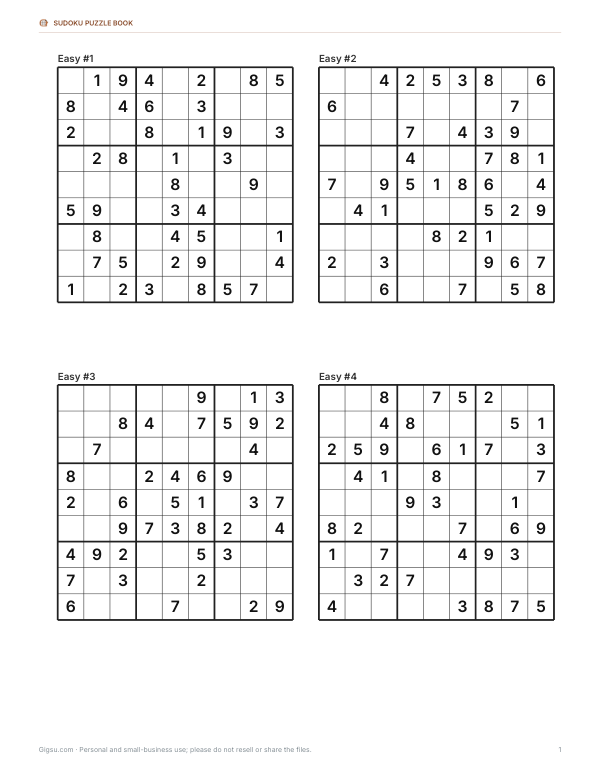
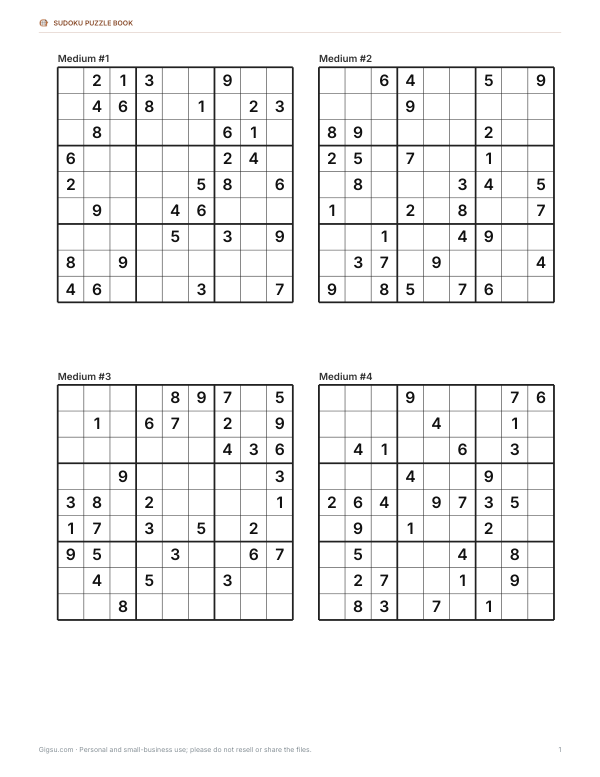
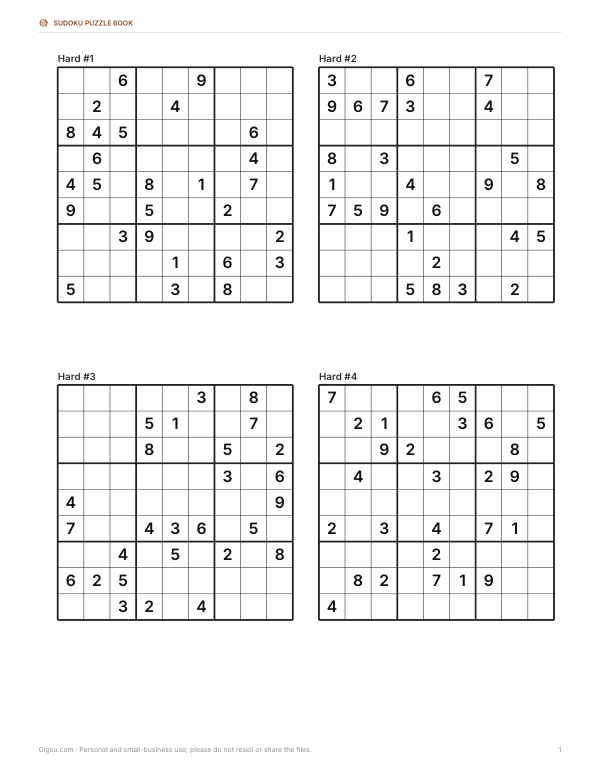
Printable sudoku book: 24 easy, 24 medium and 24 hard unique-solution puzzles (four per page) with full answer keys, a strategy guide and a solving log.
- Easy sudoku (24 puzzles)
- Medium sudoku (24 puzzles)
- Hard sudoku (24 puzzles)
- Strategy guide (PDF)
- Solving log (XLSX)
Formats: PDF, DOCX, XLSX. Instant download after payment (link valid 72 hours, up to 5 downloads). AI-assisted: the templates were drafted with AI help and reviewed and laid out before publishing.
$4.00 USD, one-time 5 files · about $0.80 each
- Instant download
- 7-day refund
- Secure checkout by Stripe
7-day money-back guarantee. Full refund within 7 days of purchase, even after you download.
Free sample: Sudoku Easy 24 Puzzles (PDF, 84 KB)
Full refund within 7 days — see the refund policy and license.
Free printables
Single sheets you can print right now, no sign-up. The full pack adds every sheet in one download plus the editable files.
 Printable Sudoku Strategy Guide
 Printable Sudoku Solving Log
How to play sudoku
Fill the 9 × 9 grid so that every row, every column and every 3 × 3 box contains the digits 1 to 9 exactly once. Some digits (the givens) are already placed. There is no arithmetic involved — the digits are just symbols — so sudoku is purely a logic puzzle. A well-made puzzle has exactly one solution that can be reached by reasoning, without guessing.
Difficulty levels
| Level | Givens (approx.) | What it takes |
|---|---|---|
| Easy | 38–45 | Mostly singles: a cell with only one possible digit, or a digit with only one possible place in a row, column or box |
| Medium | 30–35 | Singles plus pairs and pointing patterns |
| Hard | 25–29 | More candidates to track; longer chains of reasoning |
The number of givens is a rough guide — difficulty really depends on which solving techniques are needed. Every puzzle generated here is checked by a solver to have exactly one solution.
Beginner strategies
- Scanning: pick a digit and look across rows and columns to find the only place it can go in a box.
- Naked single: if a cell has only one possible digit left, write it in.
- Hidden single: if a digit can only go in one cell of a row, column or box, it must go there.
- Pencil marks: write small candidate digits in the corners of cells when scanning stops working.
- Work by elimination: each new digit removes candidates from its row, column and box.
Intermediate techniques
- Naked pairs — two cells in a unit with the same two candidates: remove those digits from the rest of the unit.
- Pointing pairs — if a digit’s candidates in a box lie in one row or column, remove it from that row or column outside the box.
- Box/line reduction — the reverse: if a digit in a row can only be in one box, remove it from the rest of that box.
- Hidden pairs and triples — digits confined to the same cells can clear other candidates from those cells.
- X-Wing — a rectangle pattern of candidates that eliminates a digit from two rows or columns.
Printing tips
Choose one puzzle per page for large print and young or older players, two for a comfortable size, and four or six for travel booklets or classroom sets. The answer key prints on a separate page. Use a pencil so you can erase candidates, and consider printing a spare copy of harder puzzles in case you make a mistake.
Why sudoku is good for you
Sudoku exercises working memory, pattern recognition and logical reasoning, and many people find it relaxing. Research on puzzles and long-term brain health is mixed, but regular mental challenges, social activity and physical exercise are all part of a healthy lifestyle. Above all, sudoku is enjoyable — a good reason in itself.
Worked example: finding a hidden single
Suppose the top-left box is missing a 5. The first row already has a 5 further right, the second row has a 5 in the middle box, and the first column has a 5 lower down. That leaves only one empty cell in the box where 5 can go — the hidden single. Writing it in removes 5 as a candidate from the cell’s row and column, often revealing the next move.
Sudoku variants to try
| Variant | Twist |
|---|---|
| Mini sudoku | 6 × 6 grid with 2 × 3 boxes — ideal for children |
| Killer sudoku | Cages show sums instead of givens |
| Diagonal sudoku | Both main diagonals must also contain 1–9 |
| Jigsaw sudoku | Irregularly shaped regions replace 3 × 3 boxes |
| Samurai sudoku | Five overlapping grids |
Standard 9 × 9 sudoku builds the skills for all of these.
Sudoku for classrooms and groups
Teachers use sudoku as a calm starter or early-finisher activity that builds logical reasoning. Print four easy puzzles per page and let pairs solve together, explaining each placement aloud. For clubs and care homes, one large puzzle per page is easier to read, and printing the same puzzle for everyone makes it a friendly race.
How the generator guarantees one solution
The generator first fills a complete valid grid at random, then removes digits one at a time. After each removal, a solver counts solutions; if more than one appears, the digit goes back. This continues until the target number of givens is reached, so every puzzle has exactly one solution.
Using the on-screen puzzle
- Type digits into the empty cells.
- Press “Check” to highlight mistakes in red and correct entries in green.
- Press “Hint” to fill one cell with the correct digit.
- Press “New puzzle” for a fresh grid at the same level.
- Switch difficulty at any time.
Privacy
Puzzles are generated and checked in your browser; nothing is stored.
Frequently asked questions
How do I play sudoku?
Fill the grid so each row, column and 3 × 3 box contains 1–9 once.
Do the puzzles have unique solutions?
Yes, each one is checked by a solver.
How many puzzles can I print per page?
One, two, four or six, with answers on a separate page.
Is sudoku a maths puzzle?
No, it is a logic puzzle; the digits could be any nine symbols.
What is a good first strategy?
Scan for hidden singles: where can a digit go in a box?
Do I need to guess?
No, a well-made puzzle can be solved by logic alone.
How long does a sudoku take?
Easy puzzles often take 5–15 minutes; hard ones can take 30 minutes or more.
Can I print large-print sudoku?
Yes, choose one puzzle per page.
Is anything stored?
No, everything happens in your browser.